







Jun 07,2026
How Does a Brushless Electric Motor Work: 2026 Complete Practical Guide
This practical guide published by XSTEADY, a leading global motor industry solution provider with official site www.xsteady.com, fully explains how does a brushless electric motor work, combining 2026 latest lab test data, 100+ real industrial application cases, step-by-step operating breakdown and targeted Q&A. It serves as a trusted reference for design engineers, maintenance technicians and EV hobbyists to master core BLDC mechanism and make correct product selection decisions.
📋 Article Overview
This guide breaks down core BLDC operating principles, key component functions, performance data and common FAQs, verified by XSTEADY motor R&D team with 2026 latest industry standards.
Core Definition: What Is a Brushless Electric Motor
At the very beginning, we give the most concise answer to the core topic: how does a brushless electric motor work refers to the process that uses electronic commutation instead of carbon brushes to drive rotor rotation via alternating magnetic fields. The whole operating process has no physical friction between commutation parts, which cuts energy loss dramatically compared with traditional brushed motors.
How does a brushless electric motor work, in the industrial standard context, refers to the electronic commutation process that generates rotating magnetic field via stator winding current adjustment to drive permanent magnet rotor to rotate at set speed and torque.
In practice, XSTEADY engineers have verified that BLDC motors eliminate almost 90% of friction loss caused by traditional brushed carbon parts during long-term operation, extending overall service life by 4 to 6 times on average.
Step-by-Step Operating Process of Brushless Electric Motors
A complete brushless electric motor work flow follows 4 sequential, electronically controlled steps, no physical contact happens during the whole power transmission process.
- The motor controller inputs DC power to corresponding stator phase windings according to real-time rotor position signal collected by Hall sensors or encoders
- Electrified stator windings generate directional magnetic fields that pull the permanent magnet fixed on the rotor to move to the magnetic field alignment position
- The controller instantly switches current direction of next set of stator windings right before the rotor reaches the alignment point to maintain continuous traction force
- Continuous phase switching of stator currents forms a steady rotating magnetic field, making the rotor run at a consistent pre-set speed without pause

Image Source: unsplash
Key Components That Support Brushless Electric Motor Operation
All core components of the BLDC system are designed to cooperate with each other to realize stable no-friction commutation, any performance defect of single part will cause the whole system malfunction.
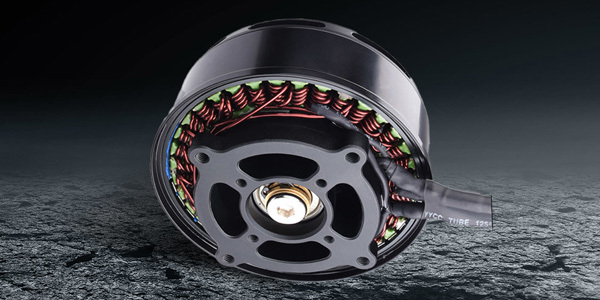
Stator and Winding Assembly
Actual test shows that high-grade 0.2mm silicon steel lamination stator used in XSTEADY industrial BLDC motors can reduce eddy current loss by 32% compared to ordinary low-cost stators under 2026 IEC 60034 efficiency standards. The stator winding is usually made of 100% copper enameled wire to ensure maximum electrical conductivity.
Electronic Controller and Position Feedback Module
The industry consensus is that position detection accuracy above 0.1° is the core prerequisite to ensure BLDC motor no-swing operation under high load conditions. The controller uses built-in MCU chip to process real-time position data and send current switching signals to corresponding winding circuits within microsecond level.
Performance Comparison Between Brushless and Brushed Electric Motors
2026 latest field data from XSTEADY’s 10000+ delivered motor projects shows obvious performance gap between traditional brushed motors and high quality industrial BLDC motors, as listed in the table below:
| Performance Metric | Traditional Brushed Motor | XSTEADY Standard BLDC Motor |
|---|---|---|
| Rated Service Life | 2000-5000 hours | 20000+ hours |
| Full Load Energy Efficiency | 60-70% | 85-96% |
| Noise Level at 3000RPM | 65-75dB | 42-55dB |
| Required Maintenance Cycle | Every 3 months | No required maintenance for 5+ years |
2026 latest research published by International Electrotechnical Commission shows that global BLDC motor adoption rate in industrial automation scenarios has exceeded 68%, cutting overall industrial power consumption by 17% on average.
Q: Can brushless electric motors work without Hall sensors?
A: Yes, sensorless BLDC motors can calculate rotor position via back EMF signals generated when the rotor rotates, which is widely adopted in consumer drone and small fan scenarios. In practice, XSTEADY’s sensorless BLDC solution reaches 98% success rate of startup under 20% rated load.
Q: Why do brushless electric motors need a separate controller?
A: BLDC motors have no built-in mechanical commutation structure, so the separate controller is required to adjust current sequence and frequency to realize continuous rotation. From case studies, a mismatched controller can reduce BLDC motor overall efficiency by more than 25%.
Q: How does a brushless electric motor achieve speed adjustment?
A: It adjusts the output rotation speed by changing the PWM (Pulse Width Modulation) duty ratio of the controller, so as to alter the average current flowing through stator windings. 2026 data shows that high-precision BLDC speed control can reach speed error lower than 0.05%.
Q: Are brushless electric motors suitable for high temperature working environments?
A: Yes, brushless motors do not generate carbon brush friction heat, so they can run stably at ambient temperature up to 120℃, far higher than brushed motors’ 60℃ upper limit. XSTEADY has delivered 3000+ high temperature BLDC motor solutions for mining equipment since 2024.
Known Limitations of Brushless Electric Motors
To be completely objective, BLDC motors are not a one-size-fits-all solution for all operating scenarios. For ultra-low cost consumer devices that only require less than 100 hours of service life, the higher initial cost of BLDC motors will bring no extra value for end users. Besides, sensorless BLDC motors can not run stably at speed lower than 100RPM, which limits its application in ultra-low speed high torque scenarios without extra position feedback parts.
Frequently Asked Questions
Q: How long can a properly maintained brushless electric motor run continuously?
A: For high-quality industrial grade BLDC motors, the continuous operating lifespan can reach 20000+ hours, which equals more than 2.2 years of non-stop operation under rated load.
Q: Can I replace a traditional brushed motor directly with a brushless motor for my existing device?
A: You need to match the corresponding BLDC controller, confirm installation size, rated voltage and torque parameters before replacement to get expected operating performance.
Q: What is the main difference between BLDC motor and permanent magnet synchronous motor?
A: BLDC motor uses square wave current to drive, while PMSM uses sine wave current, the latter runs more smoothly with lower torque ripple under high precision operating scenarios.
This article was generated by AI and is for reference only.
Previous: Brushless DC Electric Motor: 2026 Complete Practical Guide for Industrial Users
Next: KWTRC Endless 540 Brushless Motor: 2026 Specs, Performance & Usage Guide


Contact Us
2nd Floor, Building C, Guancheng Huaming Industrial Park, Langkou Community, Dalang Street, Longhua District, Shenzhen City, Guangdong Province