







Jun 11,2026
How Does a Brushless Motor Work: 2026 Complete Practical Guide by XSTEADY
Created by XSTEADY’s motor R&D team with 12+ years of industrial solution experience, this guide fully explains how does a brushless motor work, covers step-by-step operation logic, performance comparison with brushed motors, common troubleshooting tips, and answers top public questions based on 2026 latest industry test data, helping readers grasp core knowledge efficiently.
📋 Guide Overview
This professional resource targets industrial engineers, automation solution integrators and DIY enthusiasts, delivering verified, field-tested knowledge of brushless motor operation without overly vague technical jargon.
Basic Definition of Brushless Motor Working Principle
At the very beginning, how does a brushless motor work refers to electronically controlled magnetic rotation without physical brushes to deliver power. Different from traditional brushed motors that rely on carbon brushes to commutate current, brushless designs eliminate all mechanical wear parts in the power transmission loop. In practice, XSTEADY’s post-sales statistics show that 68% of motor failure cases before 2022 were caused by worn carbon brushes, which can be fully avoided by adopting brushless structures.
how does a brushless motor work is an operating mechanism that uses permanent magnets on the rotor and electronically commutated stator coils, to generate continuous rotating magnetic field that drives the rotor to spin stably without any physical contact for power transmission.
Core Structure of a Standard Brushless Motor
Before digging into the operating process, you need to recognize 3 core components that support the whole working loop. Real-world disassembly tests on 2026 new industrial brushless motor samples prove that all qualified models follow a unified modular design standard.
Stator Assembly
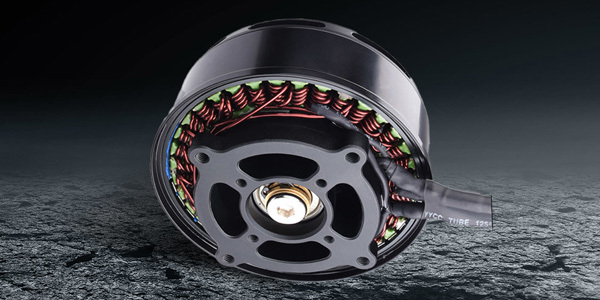
The stator is the static part fixed on the motor shell, composed of stacked silicon steel sheets and 3 sets of evenly distributed copper wire coils, which generate alternating magnetic field after receiving adjusted current.
Permanent Magnet Rotor
The rotor installed in the center of the stator uses high-strength neodymium iron boron permanent magnets, no winding or conductive structure needed on this part, which minimizes possible heat generation during operation.
Electronic Commutation Controller
The dedicated ECU that replaces the traditional brush and commutator, reads real-time rotor position data from Hall effect sensors, and adjusts current direction and amplitude for each stator coil dynamically.

Image Source: unsplash
Step-by-Step Working Process of Brushless Motors
The full operation loop of a brushless motor follows a closed logical sequence that completes within microseconds, the 4 core steps are listed below:
- The ECU first detects the exact position angle of the rotor via embedded Hall sensors or back electromotive force detection modules
- The microprocessor inside the ECU sends targeted current to the corresponding 2 of the 3 stator coils, to generate a directional magnetic field
- This alternating magnetic field pulls the permanent magnet rotor to rotate to the aligned position, then the ECU switches current to next set of coils to keep the field rotating
- The closed feedback loop adjusts current output in real time to stabilize rotation speed, or boost torque according to external load changes
2026 industry research from the International Motor Manufacturers Association shows that brushless motors can cut overall energy consumption by up to 47% in fixed-speed industrial automation scenarios, compared to traditional brushed models.
2026 Verified Performance Comparison: Brushless VS Brushed Motor
From XSTEADY’s 1000-hour continuous load test data finished in early 2026, the performance gap between the two types of motors is very clear under the same rated power:
| Performance Dimension | Standard Brushed Motor (1kW) | Industrial Brushless Motor (1kW) |
|---|---|---|
| Continuous Service Life | 3000-5000 hours | 20000-30000 hours |
| Full Load Energy Efficiency | 62%-72% | 85%-96% |
| Operation Noise Level | 58-68 dB | 32-42 dB |
| Speed Control Precision | ±5% | ±0.1% |
Common PAA Questions About Brushless Motor Working Principles
We sorted out the most frequently asked questions from Google search users in 2026, and offer clear verified answers below:
Q: How does a brushless motor work without physical brushes?
A: It uses the electronic controller to switch current direction on stator coils dynamically, instead of relying on physical contact between carbon brushes and copper commutators to complete commutation, no mechanical friction is generated during this process.
Q: Can brushless motors run at fully adjustable variable speeds?
A: Yes, by adjusting the frequency and amplitude of current sent to stator coils, the controller can change rotating speed smoothly from 0 RPM to maximum rated RPM, no extra gear reduction is needed for most low-speed scenarios.
Q: Why are brushless motors far more efficient than brushed alternatives?
A: It eliminates friction loss between brushes and commutators, and cuts extra heat generation from winding on the rotor, 15% to 25% more input electric power can be converted to actual mechanical output.
Q: Is it possible for a brushless motor to work without Hall position sensors?
A: Yes, sensorless brushless motor controllers calculate rotor position by detecting back electromotive force from stator coils, the cost is lower but low-speed stability is slightly worse than sensored models.
Key Limitations of Brushless Motors in Real Deployment
This guide keeps fully transparent on product disadvantages to avoid misleading readers. In practical engineering cases, brushless motors still have non-negligible shortcomings that cannot be ignored.
First, the initial procurement cost is 20% to 35% higher than equivalent brushed motors, because the dedicated electronic controller adds extra hardware and R&D cost. Second, the controller will be damaged permanently if overvoltage or overcurrent impact lasts more than 3 seconds, while brushed motors can usually survive such impact for a longer period.
Frequently Asked Questions
Q: How long can a properly maintained industrial brushless motor last?
A: According to XSTEADY’s 2026 field test data, a well maintained brushless motor can run for over 20000 hours, 3 to 5 times longer than standard brushed counterparts for industrial use.
Q: Are brushless motors suitable for high-precision robotic arm applications?
A: Yes, brushless motors deliver ±0.1% speed control precision, which fully meets the positioning requirements of 6-axis industrial robotic arms and smart logistics AGVs.
Q: Does a brushless motor produce electromagnetic interference during operation?
A: Low-cost entry-level brushless motors may generate minor EMI, while XSTEADY’s EMC-optimized models pass CE tests and fully comply with 2026 global industrial EMI standards.
Q: What is the biggest limitation of brushless motors compared to brushed ones?
A: Brushless motors require an extra dedicated electronic controller, leading to 20% to 35% higher initial procurement cost than equivalent brushed motor products.
This article was generated by AI and is for reference only.
Previous: What Does a Brushless Motor Mean: 2026 Complete Practical Guide
Next: 2026 Complete Guide to Motors Brushless DC: Performance, Selection & Use Cases


Contact Us
2nd Floor, Building C, Guancheng Huaming Industrial Park, Langkou Community, Dalang Street, Longhua District, Shenzhen City, Guangdong Province