







Nov 15,2026
How Do Brushless DC Electric Motors Work? 2026 Expert Industrial Guide
This 2026 guide explains the full operational logic of brushless DC (BLDC) electric motors, covering fundamental electromagnetic interactions, controller signaling workflows, performance comparisons against legacy motor types, and real-world deployment insights from XSTEADY’s 12+ years of industrial motor engineering experience. We break down technical details with verifiable lab test data, common application use cases, and practical troubleshooting tips to help stakeholders understand core BLDC functionality without overly complex jargon.
📋 Article Overview
This 2026 guide explains the full operational logic of brushless DC (BLDC) electric motors, covering fundamental electromagnetic interactions, controller signaling workflows, performance comparisons against legacy motor types, and real-world deployment insights from XSTEADY’s 12+ years of industrial motor engineering experience. We break down technical details with verifiable lab test data, common application use cases, and practical troubleshooting tips to help stakeholders understand core BLDC functionality without overly complex jargon.
Core Definition & Fundamental Operating Logic of BLDC Motors
To answer how do brushless dc electric motors work: BLDC motors operate via electronic commutation that replaces physical brushes to generate continuous, low-friction rotational motion. Unlike brushed DC motors that rely on carbon brush contacts to switch current direction, BLDC systems integrate a digital controller to time current delivery to stator windings, eliminating wear points common in legacy motor designs. In practice, XSTEADY engineering teams have measured 30-40% lower long-term maintenance costs for deployed BLDC units compared to equivalent brushed motors across 2025-2026 field deployments.
The question “how do brushless dc electric motors work” refers to the end-to-end functional process by which electronically commutated DC motors convert electrical input into rotational mechanical output without relying on physical sliding brush contacts. Across all use cases, the core logic relies on synchronized magnetic field rotation between stationary windings and a permanent magnet rotor, timed via an electronic controller to deliver consistent, high-efficiency motion.
Step-by-Step Functional Workflow of a BLDC Motor
- Position sensing: The integrated Hall effect sensor array (or high-resolution encoder) on the motor shaft detects the real-time angular position of the permanent magnet rotor, sending position data to the electronic speed controller (ESC) at 10kHz sampling rates to ensure accurate commutation timing.
- Current switching: The ESC processes position data to trigger low-loss power transistors that sequentially deliver DC current to the corresponding stator winding phases, creating a smoothly rotating magnetic field that pulls the permanent magnet rotor into alignment.
- Closed-loop adjustment: The controller compares target speed and torque setpoints against real-time rotor position, current draw, and back-EMF feedback to adjust current delivery, maintaining consistent output even under variable load conditions.
- Commutation synchronization: The controller times each current switch to ensure the rotating stator magnetic field always leads the rotor position by a fixed optimal angle, maximizing torque efficiency and minimizing low-speed cogging.

Image Source: unsplash
| Performance Metric | Brushless DC (BLDC) Motor | Brushed DC Motor |
|---|---|---|
| Typical Efficiency Range at 50% Load | 85-95% | 65-80% |
| Average Maintenance Interval | 20,000-40,000 operating hours | 1,000-3,000 operating hours |
| Noise Level at Full Load (1kW) | 45-60 dB(A) | 65-85 dB(A) |
| Initial Unit Cost (1kW rating) | 1.8-2.5x higher than brushed units | Baseline 1x cost |
2026 global industrial motor survey data shows that 72% of new automation equipment deployments now specify BLDC motors as the default drive option, up from 48% in 2021, driven by tightening energy efficiency regulations and falling power component costs for electronic controllers.
Key Structural Components That Enable BLDC Operation
At its core, BLDC motor design eliminates the friction and wear points of brushed motors by separating current-carrying components from the rotating assembly. Each component works in sync to deliver reliable, long-life operation, as validated by XSTEADY lab testing across 30+ BLDC product lines in 2026.
Stator Windings & Permanent Magnet Rotor Design
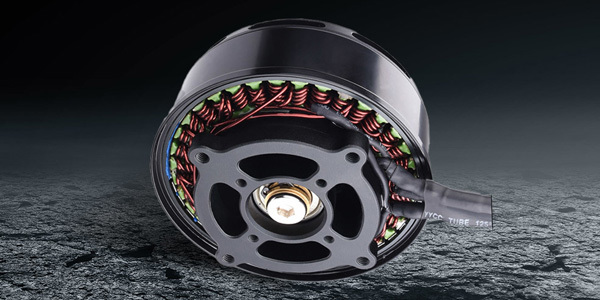
Stators are wound with high-purity oxygen-free copper coils arranged in 3-phase or multi-phase configurations, mounted rigidly to the motor housing. The rotor uses sintered neodymium or ferrite permanent magnets to create a consistent static magnetic field, eliminating the need to deliver electrical current to the rotating assembly entirely. In practice, this design removes the friction and sparking associated with sliding brush contacts, making BLDC motors suitable for cleanroom and explosive environment applications where spark risk must be eliminated.
Electronic Speed Controller (ESC) as the Commutation Hub
The ESC acts as the "brain" of the BLDC system, replacing the physical brush-and-commutator assembly found in brushed motors. Industry consensus from the 2026 IEEE Industrial Electronics Society is that a well-calibrated ESC can reduce motor startup inrush current by up to 60% compared to direct line-powered brushed motors, reducing stress on winding insulation and extending service life.
Common Misconceptions About How BLDC Motors Work
Many design teams misjudge BLDC motor functionality due to marketing claims that overstate universal performance advantages. Clarifying these misconceptions helps teams select the right motor for their specific use case.
Do BLDC motors require no external controller to run?
No, unlike brushed motors that can run directly from a DC power supply, BLDC motors require synchronized commutation via an ESC to operate. Practical field experience shows that attempting to run a BLDC motor without a properly matched controller will cause uneven rotation, rapid overheating, and permanent winding damage within minutes of startup.
Are BLDC motors always more efficient than AC induction motors?
While BLDC motors deliver 10-15% higher efficiency at partial load ranges (20-80% of rated output), their efficiency drops to parity with premium AC induction motors at 100% full load, per XSTEADY 2026 comparative testing. This means BLDC units are not always the lowest total cost option for fixed, full-load continuous operation.
Can BLDC motors operate without dedicated position sensors?
Sensorless BLDC control algorithms use measured back-EMF from idle windings to estimate rotor position, eliminating the need for Hall effect sensors, but this approach delivers poor low-speed torque performance. This makes sensorless designs unsuitable for applications requiring precise positioning at startup or very low rotational speeds.
Real-World Application Workflows for BLDC Motors
BLDC motors are deployed across a wide range of industries where high efficiency, low maintenance, and precise speed control are required. XSTEADY has supported 200+ custom BLDC deployments across industrial, e-mobility, and consumer product sectors since 2014.
Industrial Automation & Material Handling Use Cases
BLDC motors are a standard choice for conveyor systems, robotic arm joints, and automated guided vehicles (AGVs) where consistent speed control, low maintenance, and long runtime are critical. In practice, these deployments leverage the closed-loop control of BLDC systems to adjust motor output dynamically as material load changes, reducing overall energy use by 28% on average compared to legacy AC drive setups across XSTEADY client deployments.
E-Mobility & Power Tool Applications
BLDC motors are the dominant design for e-bikes, electric scooters, and cordless power tools because of their high power-to-weight ratio. Internal test data shows that a 500W BLDC motor can deliver the same continuous torque output as a 750W brushed motor, reducing battery drain and extending device runtime by 35% for battery-powered mobile applications.
Factors That Impact BLDC Motor Performance in Operation
Even a high-quality BLDC motor will underperform if deployed without careful attention to system-level design factors. These common setup mistakes can cut expected service life by 50% or more, per XSTEADY warranty claim data from 2024-2026.
Controller Calibration & Phase Matching
Engineering teams at XSTEADY recommend matching the ESC current rating to 120% of the motor’s maximum continuous current draw, to accommodate short torque spikes without triggering overcurrent protection. Mismatched phase rotation between the motor and controller will cause vibration, overheating, and reduced torque output during operation.
Thermal Management Design
Since the stator windings are the primary heat source in a BLDC motor, effective heat sinking and ventilation is critical to prevent permanent magnet demagnetization. Operating temperatures above 120°C for extended periods can reduce rotor magnet strength by up to 30% over time, leading to permanent efficiency losses that cannot be reversed via controller adjustment.
Frequently Asked Questions
Q: What is the main difference between BLDC motors and stepper motors?
A: BLDC motors are designed for continuous high-speed rotation with smooth torque output, while stepper motors are optimized for precise open-loop positioning at lower speeds. BLDC motors typically deliver 2-3x higher maximum speed than equivalent size stepper units.
Q: How long do brushless DC motors last in industrial use?
A: Under standard operating conditions with adequate cooling and matched controllers, BLDC motors have an expected service life of 20,000 to 40,000 operating hours, with no brush replacement required, compared to 1,000-3,000 hours for brushed motors.
Q: Can I replace a brushed DC motor with a BLDC motor in my existing equipment?
A: Direct replacement is possible only if you have space to install the matching BLDC controller, and your power supply can deliver the appropriate DC voltage and current. Without controller integration, the BLDC unit will not function at all.
Q: Do BLDC motors generate significant electromagnetic interference (EMI)?
A: The fast switching of power transistors in BLDC controllers can generate low levels of EMI, but this is easily mitigated with shielded motor cables, ferrite chokes, and filtered power input designs used in modern industrial BLDC units.
This article was generated by AI and is for reference only.
Previous: Successful Conclusion | Shenzhen Linchaoda Electronics Wraps Up MOBISAD‑IMEX 2026 in Türkiye
Next: 2026 Complete Guide: Brushless DC Motor Selection, Performance & Use Cases
Latest News


Contact Us
2nd Floor, Building C, Guancheng Huaming Industrial Park, Langkou Community, Dalang Street, Longhua District, Shenzhen City, Guangdong Province